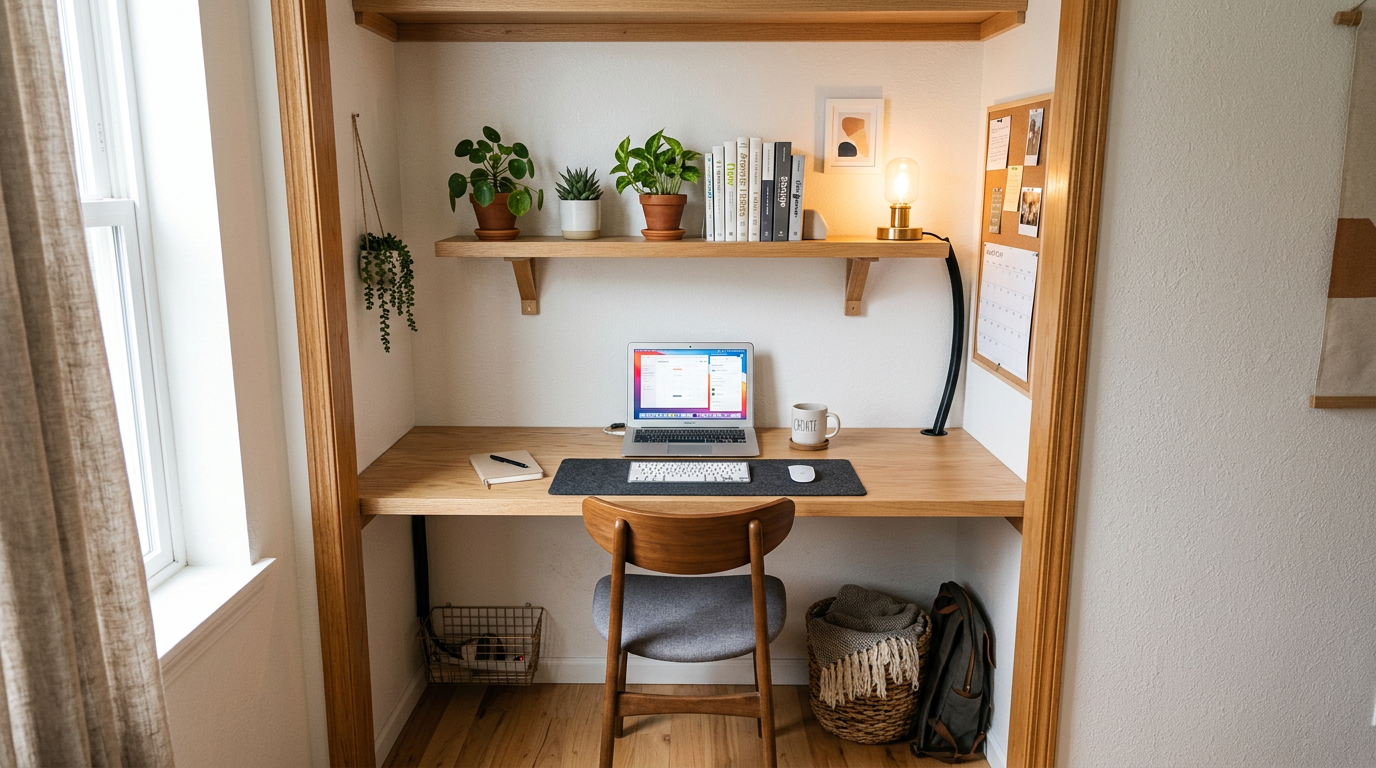
You Don’t Need a Whole Room
Not everyone has a spare room for a home office. The good news is that a productive, attractive workspace can fit in remarkably small spaces. A closet, a corner, under a staircase, or even a wide hallway can become your office with the right approach.
The Closet Office (Cloffice)
How It Works
Remove the closet doors (or replace with curtains you can draw closed after work), install a desk-height shelf across the width, add lighting and a few shelves above, and you have a self-contained office that disappears when not in use.
Key Considerations
- Depth — most closets are 24 inches deep, which is enough for a laptop but tight for a monitor. A wall-mounted monitor can help
- Lighting — closets lack natural light, so a good desk lamp is essential. LED strip lights on the underside of upper shelves add ambient brightness
- Ventilation — closets get warm. Remove the doors entirely or ensure airflow if you keep them
- Power — you may need an electrician to add an outlet, or route an extension cord neatly
Styling Tips
Paint the interior a light, bright color. Add a small shelf for a plant. Use the vertical space above the desk for organized storage. A beautiful desk setup works even in a closet.
The Corner Office
Choosing the Corner
Pick a corner with access to a power outlet and ideally near a window. Avoid corners near the kitchen or main living area traffic where distractions are constant.
Corner Desk Options
An L-shaped desk maximizes corner space. A simple floating shelf mounted in the corner with a bracket serves as a minimalist desk. A small round table works for laptop users who don’t need much surface area.
Defining the Zone
Without walls, you need visual cues to separate office from living space. A small rug under your chair, a distinct paint color on the wall behind, or a bookshelf used as a partial divider all help define your workspace. For more space-defining ideas, see our small apartment guide.
Under-Staircase Office
The triangular space under a staircase is often wasted on coats and clutter. Converting it into a desk nook can be brilliant:
- Install a desk at the tallest point where you’ll sit
- Use the lower, shorter areas for storage bins and shelves
- Add a task light and a small shelf above the desk
- Paint the nook a distinct color to make it feel intentional
Hallway and Landing Offices
A wide hallway or upstairs landing can accommodate a slim console desk against the wall. Keep the profile narrow (12-18 inches deep) so it doesn’t obstruct traffic. Wall-mounted shelves above provide storage without floor footprint.
Murphy Desk and Fold-Down Options
A wall-mounted fold-down desk provides a full work surface when needed and disappears flat against the wall when you’re done. This is the ultimate solution for truly tiny spaces or rooms that must serve multiple functions.
Making Small Offices Feel Bigger
- Light colors on walls and furniture
- Good lighting — a well-lit space feels larger
- Minimal clutter — in small spaces, every item is amplified
- Mirrors — a small mirror on the wall adds depth
- Vertical storage — shelves draw the eye upward
The Laptop-Only Advantage
If your work requires only a laptop, your office options multiply. Any surface becomes a potential desk. A tray table, a floating shelf, a kitchen counter section — laptop work is inherently flexible. Invest in a good laptop stand to maintain ergonomic positioning and a wireless keyboard for comfort.
Closing the Office
The biggest advantage of micro-offices is that they can close completely. A closet door, a curtain, a folded desk — the ability to hide your workspace at the end of the day maintains the separation between work and home life that’s essential for remote work wellbeing.