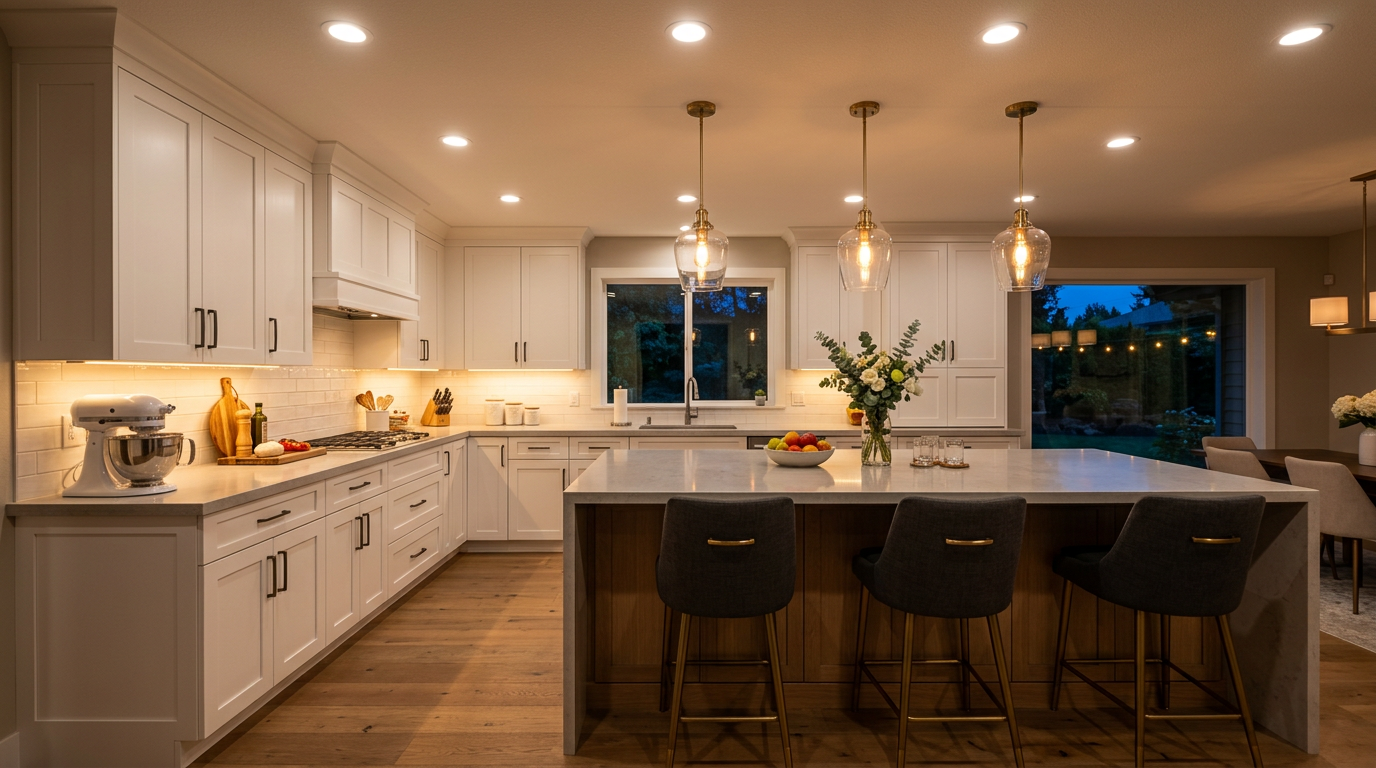
The Kitchen Needs the Best Lighting in the House
Kitchens demand more from lighting than any other room. You need to read recipes, see what you’re chopping, evaluate food color, and also create a warm atmosphere for gathering. This requires multiple layers working together.
Task Lighting
Under-Cabinet Lights
LED strips or puck lights mounted under upper cabinets illuminate the countertop where you actually work. They eliminate the shadows cast by overhead lighting and make food prep safer and easier. Warm white LEDs (3000K) are ideal.
Over-Sink Lighting
A small pendant, recessed light, or wall-mounted fixture directly over the sink provides focused light for washing and prep. This is especially important if the sink is under a cabinet rather than a window.
In-Cabinet Lighting
LED strips inside glass-front cabinets or pantry shelves make contents visible and add a warm glow to the kitchen. They’re functional and decorative.
Ambient Lighting
Recessed Ceiling Lights
Evenly spaced recessed lights provide general illumination. Space them 4-5 feet apart for a standard ceiling. Use warm white (2700-3000K) and install dimmers to control brightness based on time and activity.
Flush-Mount Fixtures
In kitchens without the ceiling height for pendants, a statement flush-mount fixture provides ambient light with style. Drum shades, glass globes, and geometric fixtures all work.
Accent and Statement Lighting
Island Pendants
Two or three pendants over the island are the kitchen’s statement moment. Space them evenly over the island’s length, 30-36 inches above the counter. Choose fixtures that complement your kitchen style — glass for modern, metal for industrial, rattan for bohemian.
Dining Nook Fixture
If your kitchen includes a dining area or breakfast nook, a pendant or small chandelier over the table creates a distinct zone with its own atmosphere.
Natural Light Strategies
Window Treatments
Keep kitchen window treatments minimal and easy to clean. Roman blinds, sheer cafe curtains, or no treatment at all maximizes daylight. If privacy is needed, a translucent film provides it without blocking light.
Skylights and Tubes
If renovating, a skylight or solar tube brings natural light into kitchens without exterior wall windows. The quality of overhead natural light in a kitchen is unmatched.
Color Temperature Guide
- 2700K — warm, golden, best for dining and mood
- 3000K — warm white, the sweet spot for most kitchen areas
- 4000K — neutral white, good for task-heavy prep areas
- 5000K+ — cool daylight, avoid in home kitchens (feels commercial)
Keep all fixtures within one or two temperature steps of each other for visual coherence.
Smart Kitchen Lighting
Smart dimmers and color-tunable bulbs let you shift from bright task lighting during cooking to warm ambient light during dinner. Program scenes for common modes: “Cooking” (bright, neutral), “Dining” (warm, dimmed), “Morning” (gradually brightening).
Common Kitchen Lighting Mistakes
- Only overhead recessed lights — flat and shadowless
- Forgetting under-cabinet lighting — your countertop is in shadow
- Pendants hung too low or too high — measure carefully
- Mixing color temperatures — keeps everything consistent
- No dimmers — full brightness at 10pm is harsh