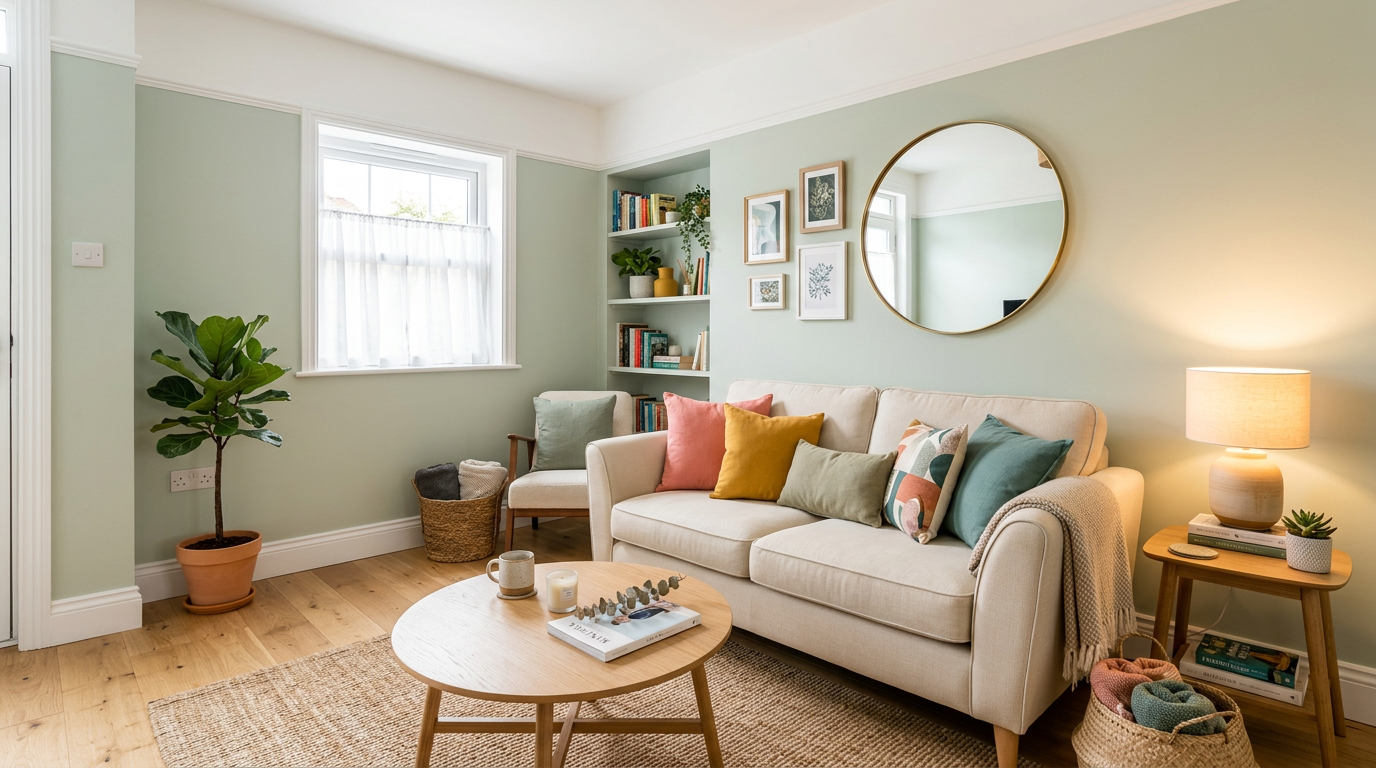
Color Changes Perceived Size
The colors in a room directly affect how large or small it feels. Light colors reflect more light and recede visually, making walls seem further away. Dark colors absorb light and advance, making walls feel closer. Understanding this lets you manipulate perceived space with paint alone.
The Light Palette Approach
All-Over Light Color
Painting walls, ceiling, and trim the same light color blurs the boundaries of the room. Without clear edges, the eye can’t calculate the room’s dimensions, and it feels larger. Warm white, soft cream, and pale gray all work beautifully.
White Isn’t the Only Option
While white is the default, very pale versions of any color work: whisper-soft blue, barely-there sage, the faintest lavender. These add character while maintaining the space-expanding effect.
Ceiling Trick
Paint the ceiling the same color as the walls (or a shade lighter). A white ceiling with colored walls creates a visible lid that stops the eye. A continuous color draws it upward.
The Tonal Approach
One Color Family
Choose one color family and use it in varying intensities throughout the room. Pale sage walls, medium sage textiles, and dark sage accessories create depth without the visual fragmentation that shrinks a room.
Low Contrast
High contrast (white walls with a dark sofa and black furniture) chops up a small room into distinct blocks. Low contrast (walls, furniture, and textiles in related tones) creates flow and continuity that feels expansive.
Strategic Dark Color
The Bold Move
Counterintuitively, some small rooms benefit from dark color. A small room painted in a rich, deep color (navy, forest green, charcoal) can feel enveloping and intentional rather than cramped. The key is consistency — paint everything the same dark color, including trim and ceiling, to create a cocoon effect.
Dark Ceiling
Painting a ceiling darker than the walls (not just white) creates intimacy and can make a room feel cozy rather than low. This works in bedrooms and dining areas where a snug atmosphere is desired.
Paint Techniques
Vertical Stripes
Subtle vertical stripes (two close-value tones) make ceilings feel taller. This works in narrow hallways and compact rooms.
Color Drenching
Painting walls, trim, ceiling, and doors the same color creates a seamless envelope that makes it impossible to judge the room’s true dimensions. It’s especially effective in very small rooms like powder rooms.
Half-Wall Color
Painting the lower portion of the wall a different color from the upper creates a horizontal line that the eye follows, widening the perceived space. Keep the upper color lighter.
Flooring Color
Light-colored flooring (pale wood, light tile, cream carpet) enhances the spacious feeling. If dark flooring is already in place, a light-colored rug covering a significant portion helps.
The Role of Gloss
Reflective Surfaces
Semi-gloss or satin finishes on walls reflect more light than matte finishes, making the room feel brighter and larger. The reflection adds subtle depth. Use in bathrooms, kitchens, and compact rooms.
Matte for Mood
In rooms where you want atmosphere over expansion (bedrooms, dining rooms), matte finishes create a velvety, sophisticated quality that works even in dark colors.
Putting It Together
For maximum space expansion: light tonal walls, continuous color to ceiling, low-contrast furnishings, and reflective finishes. For intentional coziness: consistent dark color on all surfaces with warm lighting. Both approaches work — the key is commitment. Half-measures (a dark accent wall with light walls) can highlight smallness rather than disguise it.