Noise Is the Number One Office Complaint
In surveys of office workers, noise consistently ranks as the top environmental frustration. It reduces productivity, increases stress, and makes confidential conversations impossible. Fortunately, today’s acoustic solutions are designed to be as visually appealing as they are functionally effective.
Understanding Office Acoustics
Absorption vs. Blocking
Sound absorption reduces echo and reverberation within a space. Sound blocking prevents sound from traveling between spaces. Most offices need both. Soft materials absorb; dense, massive materials block.
The Echo Problem
Hard, parallel surfaces — concrete walls, glass partitions, hard floors, flat ceilings — bounce sound back and forth, creating reverberation that makes speech muddy and noise levels uncomfortable. The solution is introducing absorptive surfaces.
Decorative Acoustic Panels
Fabric-Wrapped Panels
The workhorse of office acoustics. Fabric-wrapped acoustic panels mount to walls and ceilings, come in hundreds of colors and custom prints, and dramatically reduce reverberation. They can match your brand colors, display artwork, or create abstract patterns.
Felt Panels
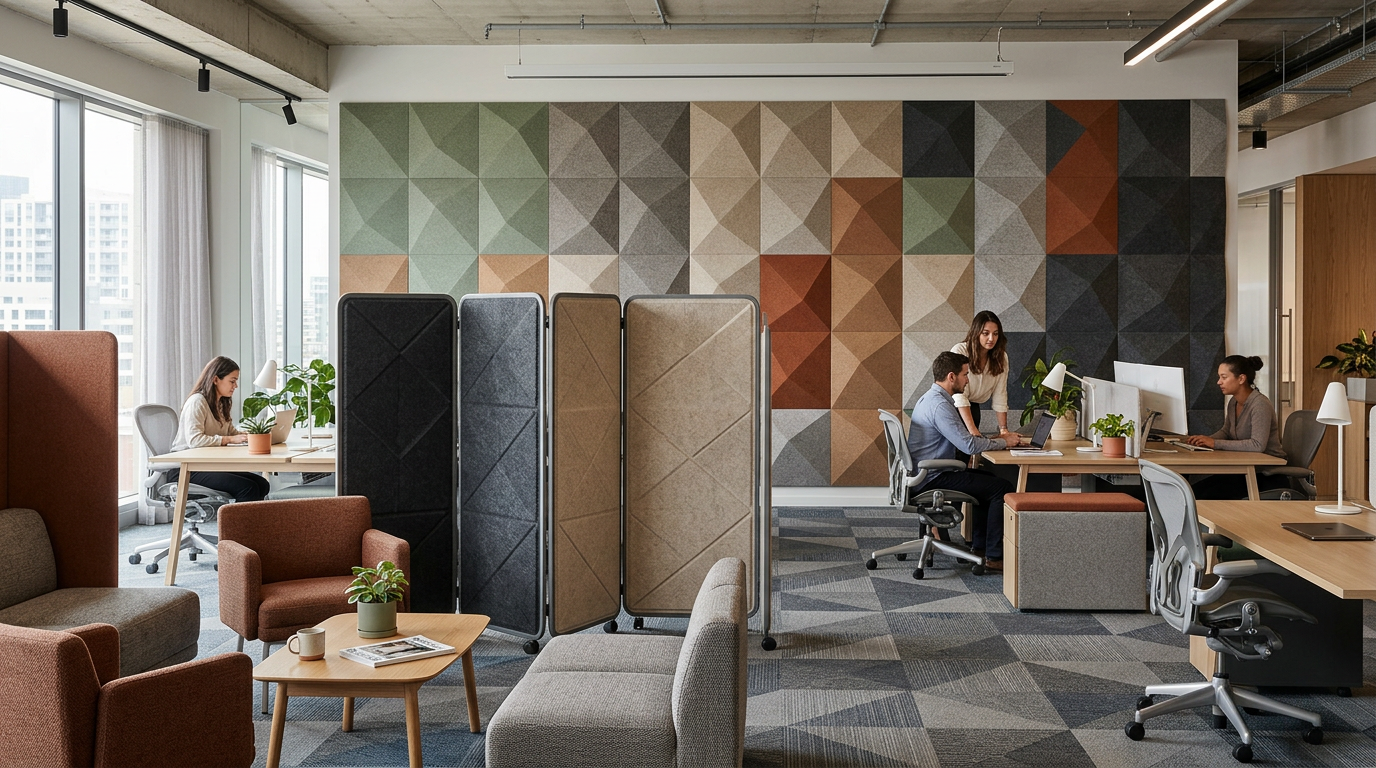
Pressed felt panels in geometric shapes, hexagons, or custom cuts create a modern, tactile wall treatment that absorbs sound. They’re often self-adhesive and easy to reconfigure.
Printed Art Panels
Acoustic panels printed with high-resolution photography, illustrations, or custom artwork serve as both art and sound treatment. No one knows they’re acoustic — they look like framed prints.
Ceiling Clouds and Baffles
Suspended acoustic panels (clouds) or vertical baffles break up the flat ceiling plane, reduce overhead sound bounce, and add architectural interest. Available in shapes from simple rectangles to organic forms.
Furniture as Acoustic Tool
High-Backed Seating
Sofas and chairs with high backs create mini sound shelters. In open offices, high-backed booth seating provides acoustic privacy for conversations without enclosed rooms.
Acoustic Divider Screens
Freestanding fabric screens between workstations provide visual privacy and sound absorption. They’re mobile, available in coordinated colors, and far more attractive than cubicle partitions.
Upholstered Pieces
Every upholstered surface in your office absorbs sound. Choosing fabric-covered furniture over hard materials is an acoustic decision as well as an aesthetic one.
Plants for Sound
Dense plantings, tall hedging plants, and living walls provide measurable sound absorption while bringing all the biophilic benefits of greenery. Large planters with leafy plants positioned between workstations serve as natural acoustic barriers.
Carpet and Rugs
Carpet is the single most effective acoustic surface in any office. Where carpet isn’t desired, large area rugs under workstations and in meeting areas provide significant sound absorption. Even a rug in a hard-floored hallway reduces footstep noise that travels throughout the space.
Curtains and Drapes
Heavy curtains along walls or as room dividers absorb mid and high-frequency sound effectively. In meeting rooms, curtains along one wall can significantly improve speech clarity.
Strategic Layout
Buffer Zones
Place storage rooms, copy areas, and other low-sensitivity spaces between noisy areas (kitchens, social spaces) and quiet work zones. These buffer zones absorb sound naturally.
Distance
Simply increasing the distance between noise sources and focused workers helps. In open plans, position phone-call-heavy roles away from deep-focus roles.
Enclosed Spaces for Noise
Meeting rooms with solid walls and acoustic doors contain conversation noise. Phone booths contain call noise. Enclosing the noise sources is often more practical than soundproofing every workstation.
Implementing an Acoustic Strategy
Start by identifying the worst noise problems — then address them with the most impactful solutions first. Wall panels in echoey meeting rooms, rugs in hard-floored open areas, and high-backed seating in collaboration zones typically deliver the best return. Layer additional treatments as budget allows.